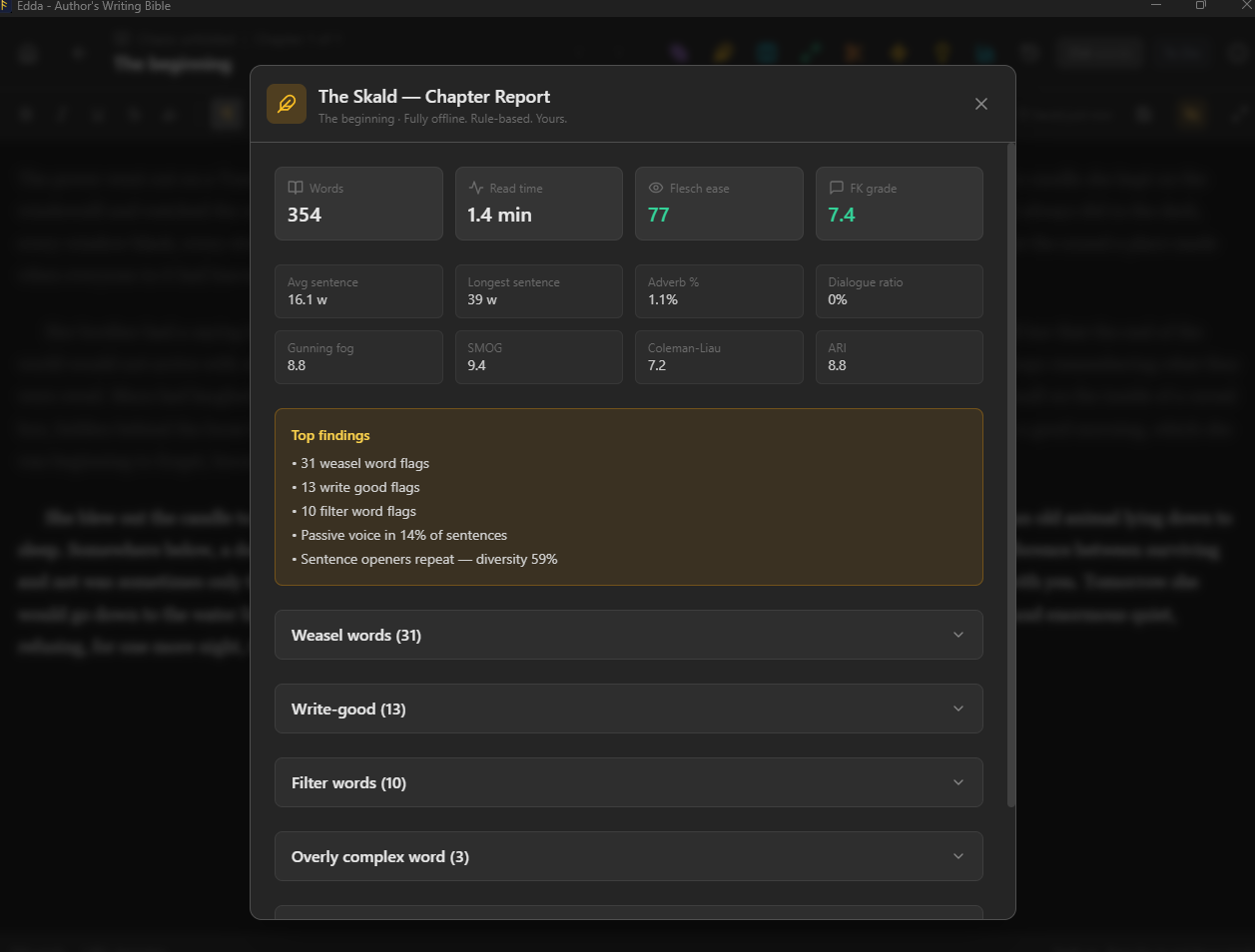
A deterministic writing assistant built into Edda. It serves prompts from a hand-curated library, flags issues against fixed rules, and scores readability with classic metrics. It never generates prose for you. It never sends a word off your machine.
Fully offline. Rule-based. Yours.
135 hand-written prompts, fifteen in each of nine categories, plus fifteen constraints. Roll for one or layer in an optional constraint. Combinatorial mode assembles a fresh premise from fixed parts (archetype, situation, complication, twist): string assembly, not text generation.
Misspellings underline as you write. Right-click for suggestions from the bundled English dictionary, or add character names, places and invented words to a project-scoped dictionary that travels with the manuscript and never syncs anywhere.
Click the feather icon, or open it from the manuscript menu, and get a structured report on a scene or a whole chapter in under two seconds: six classic readability scores, style flags grouped by type, sentence-length variance, opener diversity, dialogue ratio and word-repetition proximity. Only when you ask.
Prompts
The Skald's prompt library is curated by a human. Every entry was written deliberately. Pull a random prompt, filter by category, and optionally pair it with a constraint: "exactly 100 words," "no dialogue," "second person."
Combinatorial mode picks one archetype, one situation, one complication and one twist, then slots them into a sentence template. Because the four arrays have twenty entries each, the math gives 160,000 possible premises, all assembled from fixed strings, none generated by a model.
Combinatorial example
"Write a scene in which the gravedigger who can see the recently dead finds the body of someone who should already be dead, but the only witness is someone they love, and the truth would destroy the person it would save."
One of 160,000 possible premises. Assembled from fixed parts. No model in the loop.
Spell and dictionary
Fantasy and sci-fi authors invent words. So do romance authors with unusual character names, and mystery authors with regional dialects.
The Skald flags unfamiliar words against a bundled English dictionary, but anything you mark as "add to project dictionary" is saved with the manuscript, not a global app config that gets reset when you upgrade or switch machines.
Right-click menu
Once added, every scene in the project recognises it. Open the manuscript on another device with the same project file, and the dictionary travels with you.
The chapter report
Authors hate interruptions to flow. The Skald's chapter report is on demand: click the feather icon, get a structured second pass in under two seconds.
Each flag shows its sentence with the word highlighted. Dialogue is skipped for hedges, intensifiers, filler and vague words, because how a character talks is voice.
How it works
Prompts come from a bundled JSON library. Spell check uses a classic Hunspell-format English dictionary. Style flags come from a fixed pipeline of small, well-understood plugins. Readability is calculated with formulas published decades ago.
The Skald runs inside Edda on your machine. Spell, style and readability checks happen in milliseconds, locally. No API call, no server, no telemetry on writing content.
The same chapter analysed today returns the same report tomorrow. No temperature, no sampling, no surprise rewrites. The Skald flags issues. It never edits for you.
The Skald never generates prose. It serves you prompts, flags issues and shows you scores. The words in your manuscript are always yours, and only yours.
Straight answers
No. The Skald contains no language model and generates no text. It is deterministic: fixed rules and dictionaries that produce the same result every time on the same passage, computed on your own machine. It reads what you wrote and reports on it.
Inline spelling with a personal dictionary for invented names and places, sixteen categories of style flag including passive voice, filter words, cliches, adverb pileups and repetition, six readability scores, a per-project style sheet, and 135 hand-written prompts for when you are stuck. None of it is generated.
A rule applies fixed logic, so you can trace exactly why a flag appeared and the same text always produces the same output. A language model predicts likely text, so its output varies between runs and cannot be fully explained. One measures your writing; the other produces writing.
No. It runs entirely offline, with no network calls and no account. Nothing you write is uploaded, and nothing is used as training data.
No, and that is deliberate. It will tell you a sentence is in passive voice, or that a paragraph leans on filter words, and leave the fix to you. If you want software that drafts prose, Edda is the wrong tool and we would rather say so. See why there is no AI in Edda.
The Skald is included with every copy of Edda. One-time purchase. No subscription. No accounts. No data leaves your machine.
Get Edda from $39