Ten templates
From the Hero's Journey to Save the Cat, choose a proven structure and let Edda scaffold your narrative from act one to the final page.
Structure and plot
Every great novel starts with a plan. Edda gives you professional plotting tools so you can build your story with precision, track every thread, and never lose sight of the bigger picture.
From the Hero's Journey to Save the Cat, choose a proven structure and let Edda scaffold your narrative from act one to the final page.
Manage multiple storylines, subplots and character arcs in parallel. Know exactly where each thread stands in every scene.
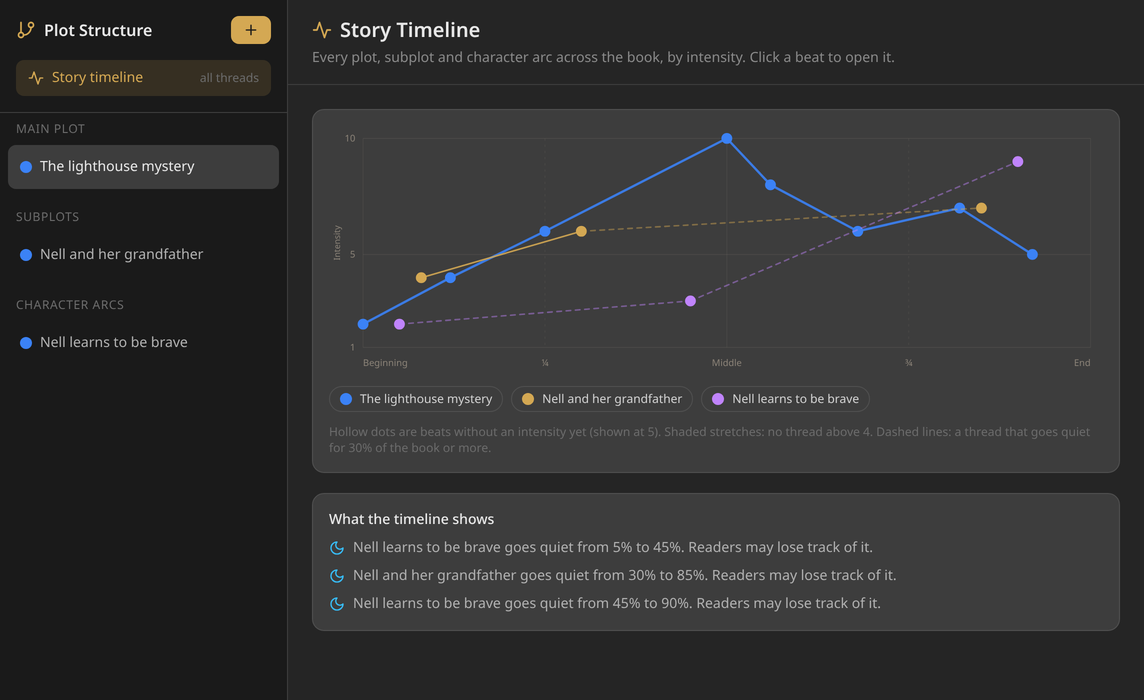
See your entire story arc at a glance. The story timeline shows pacing, tension and where every beat falls, for every thread at once.
Frameworks
Centuries of storytelling have produced structures that resonate with readers on an almost instinctive level. Select a template and Edda pre-populates your beat sheet with its key turning points, ready to modify, reorder or rename.
Setup, inciting incident, midpoint, the all-is-lost moment, climax and resolution. The backbone of Western storytelling.
The classic monomyth: ordinary world, call to adventure, mentor, ordeal, reward and return. Ideal for epic fantasy and adventure.
Blake Snyder's fifteen beats, from Opening Image to Final Image. A favourite for screenwriters and commercial fiction.
Exposition, rising action, climax, falling action, denouement. Perfect for literary fiction and stage-to-page work.
Gustav Freytag's dramatic arc with its distinct rising and falling slopes. Excellent for tragedy and classical drama.
Eight steps around the circle: You, Need, Go, Search, Find, Take, Return, Change. Intuitive and endlessly reusable.
A setup, three disasters and an ending: the spine of Randy Ingermanson's method for growing a novel from one sentence.
Hook, Plot Turn 1, Pinch 1, Midpoint, Pinch 2, Plot Turn 2, Resolution. A precise roadmap for tightly paced narratives.
Meet cute, growing attraction, first kiss, the black moment, the grand gesture and a happy ending.
The crime, the detective on the case, clues, suspects, red herrings, the midpoint revelation and the reveal.
Beats and threads
A beat sheet is the skeleton of your novel. Each beat is a turning point, a revelation, or a shift in your character's world.
Define any number of beats with descriptions and notes, assign them to scenes, and see whether each lands early or late against where the structure expects it. Save your own version of a structure as a template for the next book. Track your main plot, subplots and character arcs as separate threads that weave through your scenes, and see which threads are active in any given scene so you always know where each storyline stands.
Perspective
When you are deep inside a scene, it is easy to lose perspective on the whole. The outline view gives you a bird's-eye look at your entire manuscript: every part, chapter and scene laid out with synopses and status indicators. Drag and drop to reorganize, fold away the parts you are not working on, and the story reshapes itself around your decisions. Then the visual plot timeline lays every thread side by side, so you can see a romance simmering beneath a political thriller, spot stretches of low tension, and catch threads that go quiet for too long.
Everything included
Three-Act, Hero's Journey, Save the Cat, Five-Act, Freytag's Pyramid, Story Circle, Snowflake, Seven-Point, Romance and Mystery.
Define key beats, assign them to scenes, and track completion as your manuscript develops.
Create and manage multiple storylines that run through your manuscript in parallel.
Know exactly where each plot thread stands within any scene of your manuscript.
See all threads and their intensity across your full manuscript on one timeline, with sagging stretches and quiet threads flagged.
Rate every beat from calm to peak. Templates start you with typical values for each structure.
A high-level overview of parts, chapters, scenes and their status: To Do, Draft, Revised or Done.
Drag and drop scenes, chapters and parts to reorganize instantly.
Summaries and private notes for every scene, to plan ahead or capture context.
Keep every secondary storyline and character arc visible alongside the main plot.
Nest scenes into chapters and chapters into parts for layered structure.
Change the beats a template gives you, then save the result as your own template, ready for the next book.
Ten frameworks, every thread tracked, your whole arc visible at once. Architect it in Edda, then write it.
Get Edda from $39More features